
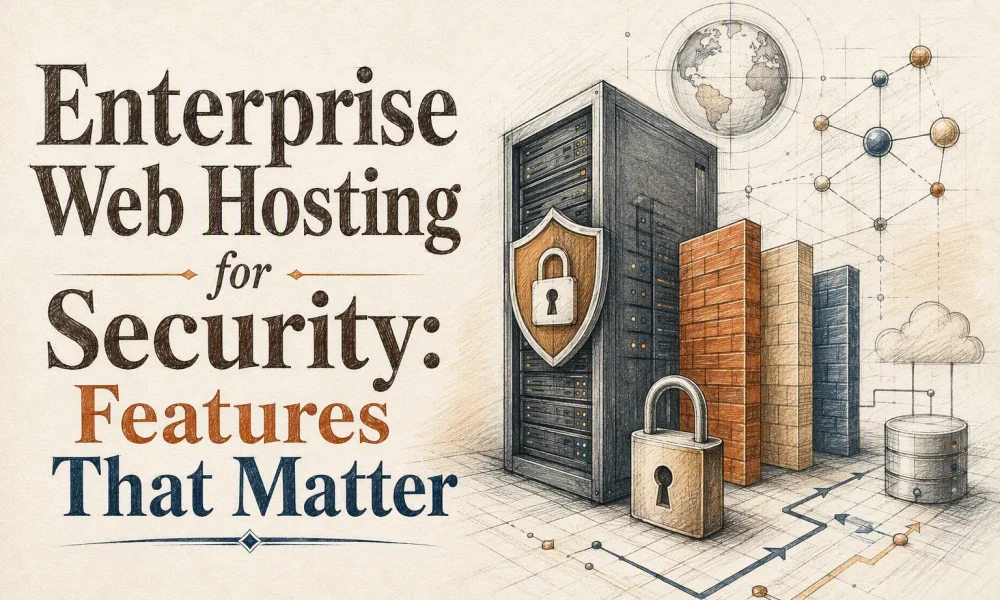

Quick Summary: A single breach from a weak admin login or failed backup can cripple a business, so enterprise hosting must defend every layer-not just servers. Look for layered defenses like DDoS filtering, Web Application Firewalls, and account isolation, plus proven backups (tested restores, not just claims) and strict access controls (MFA, quarterly admin reviews, and no shared root access). CISA warns that compliance badges alone mean nothing without documented operations-ask for audit reports, incident response times, and clear SLAs before signing, since a poorly configured site with strong hosting is still vulnerable.
One stolen admin login or failed backup can turn an agency’s client portal, store, and marketing site into one costly breach. The hard part is finding secure enterprise hosting that protects every layer, not just the server. This guide reviews the controls, recovery plans, and provider duties that define secure enterprise hosting. It helps you judge secure enterprise claims with practical buying criteria.
What Makes Enterprise Hosting Secure?
Start at the Network and Application Edge
Strong hosting blocks threats before they reach your site. Look for DDoS filtering, a web application firewall, managed TLS, rate limits, and logs your team can review. CISA notes that DDoS attacks can target volume, protocols, or the application layer, so one control is not enough. CISA’s guidance supports layered defenses.

Ask who monitors alerts, patches edge systems, and responds after hours.
Look for Isolation and Secure Defaults
Your workload should not share risky access with other customers. Choose account or container isolation, least-privilege access, MFA, offsite backups, and fast patching. CISA says segmentation limits lateral movement after a breach. Its website guidance also calls for HTTPS, logging, and secure server settings.
Also Read: Enterprise Web Hosting: 7 Providers Built for Uptime
Evaluate Identity, Monitoring, and Operational Control
Require Strong Administrative Governance
Treat hosting access as a controlled business process. Require phishing-resistant MFA, role-based access, separate admin accounts, and fast offboarding. CISA advises teams to reduce, restrict, audit, and monitor privileged accounts in its misconfiguration guidance.
- Name every account owner.
- Review admin rights each quarter.
- Ask who can approve emergency access.
Warning: A provider that shares root access without audit trails shifts too much risk to you.
Verify Monitoring and Response Visibility
Ask for clear logs, alerts, escalation times, and an incident contact. CISA logging guidance recommends central logs for user activity, admin actions, and high-risk alerts.
- Confirm who watches alerts.
- Request a sample incident report.
- Test the support path before signing.
Also Read: Enterprise Web Hosting vs VPS Hosting for Big Traffic
Test Resilience: Backups, Recovery, and Availability
Demand Recoverable, Independent Backups
A backup only counts if you can restore it. Require encrypted, isolated copies outside the production account, plus routine full-site restore tests. CISA advises offline backups and regular checks of their availability and integrity.

Ask for proof of the last successful restore test, not a backup feature list.
Match Resilience to Business Impact
Set a recovery time objective and recovery point objective based on lost sales, client harm, and legal risk. Critical stores need faster recovery than brochure sites. Confirm how the provider handles hardware failure, regional outages, and support escalation. CISA recommends scheduled recovery tests to confirm backup integrity and business needs.
Also Read: Related Posts – Talos Hosting Blog
Check Compliance Evidence and Choose the Right Provider
Validate Claims, Scope, and Shared Responsibility
Ask for current audit reports, certificate scope, and the exact services covered. A badge alone proves little. CISA notes that providers secure underlying infrastructure, while customers must secure their own settings and logs.
- Confirm the report date and assessor.
- Check data center, backup, and support scope.
- Get patching, incident response, and breach notice terms in writing.
Warning: A compliance claim does not cover a poorly configured site or weak admin account.
Use a Security Buying Scorecard
Score each provider before comparing price. Give more weight to proof and response than feature lists.
| Area | What to score |
|---|---|
| Evidence | Current audits and clear scope |
| Operations | Patching, monitoring, response time |
| Control | MFA, backups, access logs |
| Contract | SLA, liability, notification terms |
- Set a minimum score for each area.
- Reject vague answers.
- Choose the provider that documents accountability.

Choose Talos Hosting for secure US-based hosting, fast NVMe and LiteSpeed performance, and predictable lifetime pricing without renewal surprises.
Frequently Asked Questions
Q1: Recommend enterprise hosting with strong security?
Choose a host with US data centers, daily backups, Web Application Firewall protection, malware scans, and fast incident support. Talos Hosting is a strong fit for teams that value NVMe speed, LiteSpeed, and stable lifetime pricing.
Q2: Which security feature matters most?
No single feature is enough. Prioritize layered controls: a firewall, DDoS defense, backups, account isolation, and rapid patching.
Q3: How often should backups run?
Run daily backups at minimum. For stores or high-change sites, use frequent offsite backups and test restores each quarter.
Conclusion
Choose enterprise hosting with MFA, patching, backups, logs, and clear incident ownership. CISA also urges tested recovery plans. Strong security is proven through operations, not a feature list.

High Performance Web Hosting: 10 Fast Options for 2026
Enterprise Web Hosting vs VPS Hosting for Big Traffic




No Comment! Be the first one.