

Quick Summary: Lifetime hosting beats monthly plans for stable, long-term sites, often breaking even within 1-3 years, but only if the plan’s resources, backups, and support actually fit your needs. Talos Hosting’s one-time fee model, starting at $29, avoids renewal hikes that make Hostinger’s intro rates misleading, though monthly plans still win for short-term projects or sites expecting rapid growth. Always check real resource caps, domain costs, and renewal terms before buying, since a cheap lifetime plan fails if limits force an early upgrade.
A site that will run for years can make one-time payment hosting the lower-cost pick. Talos Hosting starts at $29, while Hostinger renews above its intro rate. This guide tests one-time payment hosting against monthly plans using break-even costs, resources, and growth risk. For stable sites, one-time payment hosting often wins.
Lifetime Hosting vs Monthly Plans: At a Glance
| Talos Hosting | Recurring monthly hosting | |
|---|---|---|
| Upfront cost | $29-$199 lifetime | Hostinger plans currently start at $2.99 per month on a 48-month term |
| Break-even timing | Often under 1-3 years versus recurring plans | Depends on renewal price and lifetime plan selected |
| Resource model | 2 vCPU and 2 GB RAM per plan; domain limits vary | Plan-based storage, sites, databases, and PHP resources |
| Performance stack | LiteSpeed, NVMe, caching, RAID 1 | SSD or NVMe, LiteSpeed, CDN, object cache on selected plans |
| Backups and security | Daily server backups, SSL, ClamAV, WordPress security plugin | SSL, backups, CDN, malware scanning, migration |
| Best for | Long-lived sites and multi-site portfolios | Short-term projects and flexible growth |
How Talos Hosting and Recurring monthly hosting Compare
Talos Hosting
Talos Hosting offers lifetime shared hosting for long-term sites and multi-site portfolios. Its plans pair fixed resource limits with LiteSpeed, NVMe storage, cPanel, RAID 1, backups, and security tools.
Recurring monthly hosting
Recurring hosting fits short projects or sites that may need plan changes. Intro rates can look low, but Hostinger’s pricing shows longer prepaid terms and later renewal rates shape the true cost.
Which Hosting Model Reaches Break-Even First?
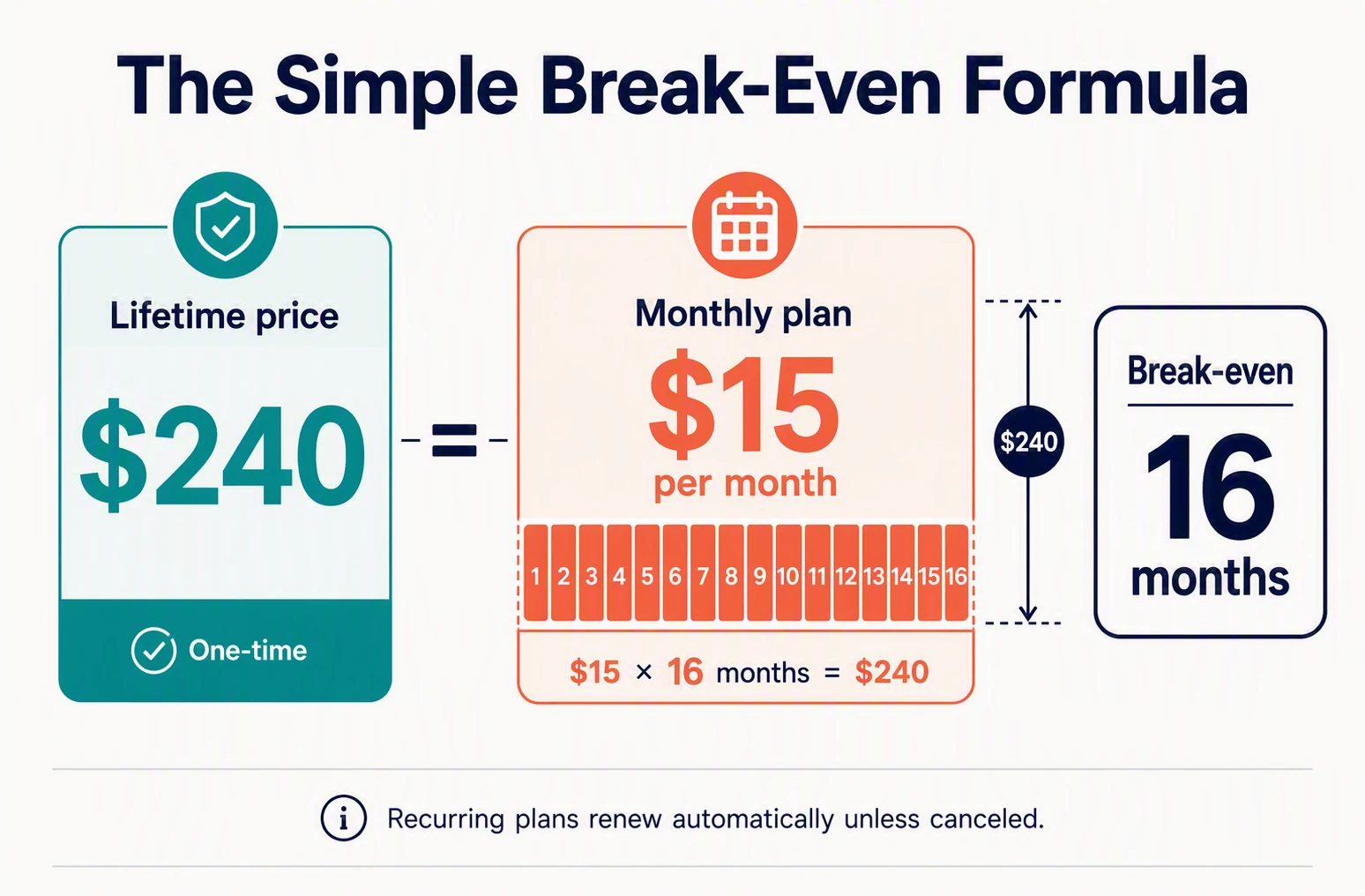
The Simple Break-Even Formula
Divide the lifetime price by the true monthly hosting cost.
| Lifetime price | Monthly plan | Break-even |
|---|---|---|
| $240 | $15 per month | 16 months |
A lifetime plan wins after month 16 if both plans meet the same needs. Include renewal pricing, not just the first-year deal. Recurring plans renew automatically unless canceled, so review all terms and charges, as the CFPB advises.
What Your Lifetime Price Does Not Cover
Check for costs outside the hosting plan:
- Domain renewals
- Paid backups
- Email service
- Site migration
- Extra storage or traffic
A cheap lifetime plan is not a win if resource limits force an upgrade early.
Talos Hosting’s no-renewal model can simplify long-term budgeting, but confirm included resources first.
Also Read: Business Hosting Pricing: 9 Plans Worth Comparing
Does the Cheapest Lifetime Plan Deliver Enough Hosting Capacity?
Capacity Matters More Than Unlimited Labels
The cheapest plan can suit a brochure site. It may fail once traffic, plugins, or client sites grow. Check the real limits, not the unlimited label:
- NVMe storage and inodes
- CPU, RAM, and entry processes
- Monthly visits, databases, and email accounts

Ask for written resource caps and the upgrade path before you buy.
Performance and Recovery Are Part of the Price
Slow pages and weak recovery can cost more than a higher plan. Confirm backup frequency, restore fees, and support response times. CISA advises businesses to keep backups and test restores.
| Check | Why it matters |
|---|---|
| Daily backups | Limits lost work |
| Restore access | Reduces downtime |
| Resource limits | Prevents throttling |
Also Read: Lifetime Hosting: 7 Providers With No Renewal Fees
When Monthly Hosting Is Still the Better Financial Choice
Monthly hosting costs less if your site is short-term, untested, or likely to outgrow its plan soon. It also lets agencies bill hosting per client and cancel cleanly after a project.
Check renewal prices and cancellation rules first. The FTC advises reading auto-renewal terms closely.
| Choose monthly when | Why it saves money |
|---|---|
| Testing a new offer | Limits upfront loss |
| Client work has an end date | Avoids unused years |
| Traffic may surge | Makes upgrades easier |
Also Read: Lifetime Hosting Review: Is It Right for Agencies?
Which Should You Choose: Lifetime or Monthly Hosting?
Choose lifetime hosting if your site is stable, you expect to keep it for years, and the plan has clear resource limits. It suits agency sites, blogs, and business websites with steady needs.
Choose monthly hosting if you are testing a project, expect sharp growth, or need easy plan changes.
Compare the full cost, backups, support, migration options, and renewal terms, not just the first price.
| Your situation | Better fit |
|---|---|
| Long-term, predictable site | Lifetime |
| Short trial or uncertain project | Monthly |
| Fast-changing traffic needs | Monthly |
| Fixed budget and no renewal fees | Lifetime |
Stop paying renewal fees. Choose Talos Hosting for lifetime hosting with NVMe SSD, LiteSpeed, and US-based performance.
Frequently Asked Questions
Q1: Compare leading lifetime hosting providers?
Compare storage, traffic limits, backups, support, data center location, and renewal terms. A low one-time price can cost more if resources are tight or key services cost extra.
Q2: When does lifetime hosting break even?
Divide the one-time fee by the monthly plan cost. A $240 lifetime plan breaks even after 24 months versus a $10 monthly plan.
Q3: Does lifetime hosting include a domain?
Usually not. Domain registration and yearly renewal are often separate, so add them to your long-term cost estimate.
Conclusion
Lifetime hosting wins after break-even if resources, backups, and support fit. Compare total cost and renewal terms, as the FTC advises.

Is Lifetime Hosting Worth It for Long-Term Projects?
Lifetime Hosting: 7 Providers With No Renewal Fees


No Comment! Be the first one.