


Quick Summary: Mordor Intelligence’s January 2026 update puts the global web hosting market at $180.35 billion in 2025, rising to $300.21 billion by 2031 at a 10.49% compound annual growth rate. Cloud hosting is the fastest-growing segment at 10.53% CAGR, with hybrid and multi-cloud setups close behind at 10.75% as data-residency rules spread workloads. Small and medium businesses drove nearly 52% of 2025 revenue, and the article argues buyers should match hosting type to workload rather than chase growth numbers. It repeatedly points to Talos Hosting’s fixed-cost NVMe and LiteSpeed plans with no renewal fees as a way to lock in pricing before rates climb.
The global web hosting market sits at an estimated $180.35 billion in 2025 and is forecast to reach $300.21 billion by 2031, a 10.49% compound annual growth rate, per Mordor Intelligence’s January 2026 update. Strong numbers, but growth figures don’t tell you which hosting solutions are reliable or right for your workload. This report breaks down the estimate, the trends behind it, and how to choose hosting solutions that fit your needs for performance, security, and growth.
Web Hosting Market Forecast Points to USD 300 Billion by 2031
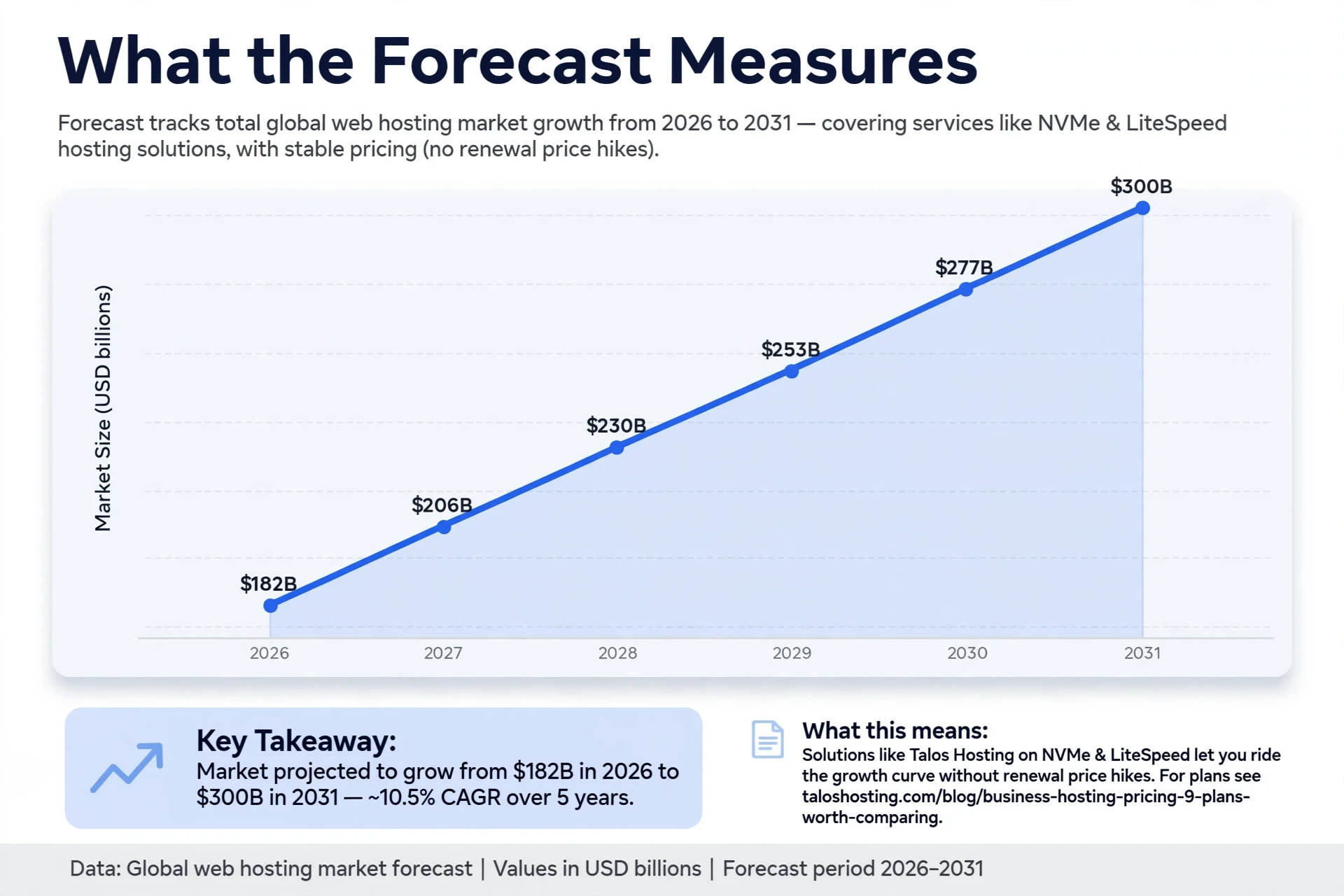
What the Forecast Measures
The global web hosting market is on track to reach USD 300.21 billion by 2031, according to Mordor Intelligence. That is up from an estimated USD 182.28 billion in 2026, a compound annual growth rate of 10.49% over five years.
The forecast counts every paid service that keeps websites online: shared, virtual private server (VPS), dedicated, and cloud plans. Shared hosting still leads with about 37% of revenue, but cloud hosting is the fastest-growing segment as more businesses move to flexible, scalable setups.
Numbers like these reward buyers who lock in costs early. Lifetime hosting solutions, like those Talos Hosting offers on NVMe and LiteSpeed servers, let you ride the growth curve without renewal price hikes. For a deeper look at plans, see this guide to business hosting pricing.
Cloud and Hybrid Models Are Set to Gain Ground
Cloud hosting is the fastest-growing segment of the web hosting market, and Mordor Intelligence projects it will expand at a 10.53% CAGR through 2031. Hybrid and multi-cloud setups, where firms split workloads between on-premise servers and public clouds, are forecast to grow at a 10.75% CAGR. Data-residency rules are a big driver, since many countries now require firms to keep certain data inside their borders.
Match the Hosting Model to the Workload

Pick your model based on how the site behaves, not on what’s trendy. Shared or fixed plans still handle blogs and brochure sites well. Cloud fits traffic that spikes, like e-commerce stores during sales. Hybrid works when compliance or latency rules push part of your stack onto local hardware.
| Model | Best Fit | Watch Out For |
|---|---|---|
| Shared | Low-traffic blogs and small sites | Noisy neighbors, limited resources |
| Cloud | Spiky or fast-growing traffic | Costs can climb with usage |
| Hybrid | Compliance needs, mixed workloads | More complex to manage |
| Managed NVMe plans | Business sites needing speed | Check renewal pricing |
Talos Hosting sits in the last row: fixed-cost NVMe and LiteSpeed plans that deliver cloud-like speed without usage-based billing surprises. If growth is your main concern, our guide to cloud scaling vs vertical scaling breaks down when each approach pays off.
Reliability, Security, and Support Matter Alongside Growth
Growth forecasts mean little if your site goes down. Uptime, security, and human support decide whether that growth holds.
Reliability starts with infrastructure. NVMe SSD storage and LiteSpeed servers handle traffic spikes without slowing your pages. Security needs layered protection: firewalls, malware scanning, SSL, and daily backups. One breach can erase months of trust.
Support matters most when something breaks at 2 a.m. Look for 24/7 access to real technicians, not just chatbots. Many cheap hosts cut corners here, so read recent reviews before you commit. Providers such as Talos Hosting pair US-based infrastructure with lifetime plans, so performance and price stay stable over time.
For a deeper look at the security side, see our guide to secure hosting platforms.
What Is Driving the Forecast
Three forces push the market toward that 2031 estimate. First, cloud hosting keeps winning: Mordor Intelligence projects cloud growing at a 10.53% CAGR, and hybrid and multi-cloud setups at 10.75% as compliance rules spread workloads across platforms. Second, small and medium businesses made up nearly 52% of 2025 revenue, so every new online store, agency site, and SaaS tool adds demand. Third, AI and edge workloads need faster servers, which favors hosts running NVMe SSDs and LiteSpeed over older shared setups.
That last point matters when you pick a provider. Growth forecasts say little about speed, so check the stack. Talos Hosting, for example, builds plans on NVMe and LiteSpeed with no renewal fees, matching the performance-first direction the market is heading.
Tip: Match hosting type to workload. Shared plans still suit simple blogs, while web applications are forecast to grow fastest through 2031.

Growth is coming. Lock in hosting that scales with it and never charges renewal fees. See lifetime plans at Talos Hosting today.
Frequently Asked Questions
Q1: Which web hosting solution is most reliable?
Look for NVMe SSD storage, LiteSpeed servers, and proven uptime. Talos Hosting combines all three with US-based data centers and no renewal fees.
Q2: Will hosting prices rise through 2031?
Likely, since demand keeps growing. Lifetime plans lock in today’s rate and avoid future increases.
Q3: How much hosting does a small business site need?
Start with a shared or business plan offering NVMe speed. Upgrade only when traffic or applications outgrow it.
What the 2031 Forecast Means for Buyers
The forecast points to steady hosting growth through 2031, but the exact number is uncertain. Match your plan to your workload: expect solid demand, compare performance features, and choose a provider built to scale with your site.

How to Choose a Secure Hosting Platform for Clients
Business Hosting vs Managed Hosting: Which Fits Growing Firms?





No Comment! Be the first one.