
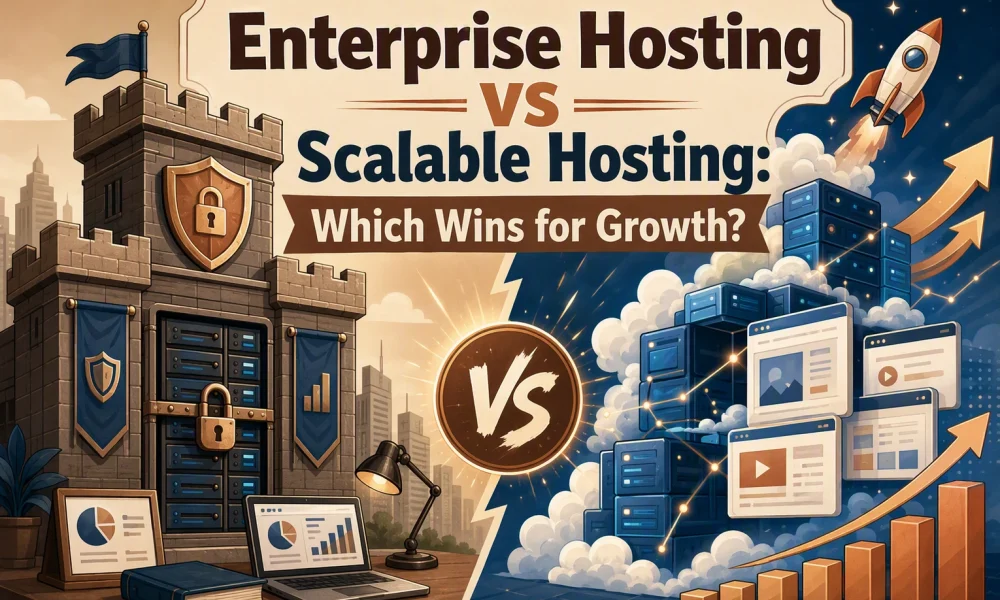

Quick Summary: Enterprise hosting offers predictable performance, strict security, and control, ideal for mission-critical and regulated businesses. Scalable hosting provides flexible, on-demand resources suited for fast-growing sites with unpredictable traffic. Choose enterprise hosting if minimizing risk and downtime is crucial, or opt for scalable hosting to support rapid growth and traffic spikes.
Enterprise hosting fits businesses that cannot risk downtime, weak support, or shared risk. Enterprise hosting gives isolation, SLAs, and clear accountability. Scalable hosting fits teams with changing traffic and fast growth. Many buyers compare both because they need room to grow without losing control. This guide explains performance, support, compliance, and growth tradeoffs so you can pick enterprise hosting or scalable hosting with confidence.
Enterprise Hosting vs Scalable Hosting at a Glance
| Enterprise hosting | Scalable hosting | |
|---|---|---|
| Performance consistency | Very high and predictable | Good, but variable under changing load |
| Scaling model | Planned expansion with reserved resources | Elastic, on-demand resource growth |
| Operational control | High control over configuration and governance | Moderate, often managed through a platform |
| Compliance and security | Strong compliance posture and integrated security | Depends on provider and tier |
| Best for | Mission-critical systems and regulated businesses | Growing sites and traffic-spike workloads |
| Support model | 24/7 accountable, SLA-backed support | Managed support, usually tier-based |
How Enterprise hosting and Scalable hosting Compare
Enterprise hosting
Enterprise hosting is built for sites and apps that cannot afford downtime, weak security, or vague support. It fits larger teams, regulated firms, and businesses that need strict control, stable performance, and SLA-backed service.
Scalable hosting
Scalable hosting is made to grow fast as traffic, storage, or app demand changes. It fits startups, agencies, and growing brands that want flexible resources without moving to a fully enterprise stack.
Performance and Reliability: Predictability vs Elasticity
Stable performance wins when every second of delay hurts revenue, trust, or team output. Enterprise hosting fits this need because it aims for tighter control, clearer SLAs, and stronger uptime goals. An SLA defines availability and response targets, while high availability focuses on keeping service up through faults, according to Wikipedia’s SLA overview and high availability summary.
Elastic scaling wins when traffic jumps are hard to predict. NIST defines cloud computing by its rapid elasticity, meaning resources can be added or removed fast as demand changes (NIST cloud definition). That helps launches, viral spikes, and seasonal stores. Still, scaling does not always mean steady speed. If your app needs consistent response times more than burst room, pick predictability first.
Also Read: Business Hosting Pricing: 9 Plans Worth Comparing
Security, Compliance, and Support: What Growth Teams Actually Need
Compliance-heavy teams usually pick enterprise hosting because risk costs more than extra capacity. Google Cloud lists third-party verified controls for SOC 1, SOC 2, SOC 3, PCI DSS, FedRAMP, and HIPAA support in its compliance resource center. That matters if you handle payments, health data, or client contracts with audit terms.

If an outage, breach, or audit failure can hurt revenue or trust fast, buy for control first.
Fast-moving teams often value managed scalability more because speed wins. AWS says managed services add 24×7 coverage, incident response, automation, and guardrails that reduce operational load while helping teams stay agile through growth at AWS Managed Services. For agencies and SaaS teams, that means fewer late-night fixes and more room to ship.
Also Read: Uncategorized – Talos Hosting Blog
Which Should You Choose for Growth?
Choose enterprise hosting if an outage, breach, or slow recovery would hurt revenue, trust, or contracts. It fits stores, SaaS apps, client sites, and regulated work that need tighter control. Even a 99.9% SLA still allows about 8.76 hours of downtime per year, according to Cloud SLA guidance.

Pick enterprise when business risk costs more than extra hosting spend.
Choose scalable hosting if traffic swings fast, launches happen often, or demand is still hard to predict. Flexera’s 2026 State of the Cloud Report says hybrid cloud remains the dominant setup, which shows why elastic capacity matters. Talos Hosting makes sense when you want strong performance plus room to grow without constant plan changes.
Pick hosting that grows without surprise costs. See how Talos Hosting gives you enterprise-grade speed, security, and long-term stability.
Frequently Asked Questions
Q1: Which business hosting is best for scaling?
Scalable hosting fits fast, uneven growth. Enterprise hosting fits high-risk sites that need strict uptime, control, and isolation.
Q2: Is enterprise hosting always better for large websites?
No. Large traffic alone does not require enterprise hosting. Pick it when downtime, compliance, or custom setup costs more than the higher hosting bill.
Q3: Can scalable hosting handle traffic spikes safely?
Yes, if the platform adds CPU, RAM, and bandwidth fast. Check limits, autoscaling rules, and support response before you trust peak sales days.
Conclusion
Choose enterprise hosting for control, isolation, and lower risk. Choose scalable hosting for fast growth. Recent platforms now stress resilience, testing, and stricter SLAs, not just growth AWS Azure.

Business Hosting for US Companies: What to Look For
Business Hosting Pricing: 9 Plans Worth Comparing




No Comment! Be the first one.