


Quick Summary: NVMe SSD hosting speeds up databases and pages by slashing latency and boosting IOPS, with benchmarks showing up to 8x better database performance and P99 query latency dropping from 12.4ms on SATA to 0.89ms on NVMe. It matters most for busy WordPress or WooCommerce sites, membership platforms, and database-heavy apps, while static blogs may see little gain. Talos Hosting builds every plan on enterprise NVMe storage paired with LiteSpeed caching, offering lifetime pricing with no renewal fees.
A WooCommerce page fires database lookups for inventory, pricing, sessions, and related products before the browser gets its first byte. Storage decides how fast those lookups run, so your storage choice shapes your database speed. This guide explains how NVMe SSD hosting affects database speed and page load times, what to expect realistically, and when NVMe actually matters. It’s written for US business owners, developers, and agencies running database-driven sites.
What NVMe SSD Hosting Changes Under the Hood
NVMe replaces the old SATA path with a direct PCIe connection to the CPU. The result: faster reads, shorter waits, and far more parallel work per second.
NVMe vs. SATA SSD in Practical Terms
Both use flash chips, but the interface differs. SATA caps out near 550 MB/s because it reuses a protocol built for spinning hard drives. NVMe was designed for flash and connects straight through PCIe. That’s why TechTarget calls NVMe the new standard for SSD communication.
| Metric | SATA SSD | NVMe SSD |
|---|---|---|
| Sequential read | ~550 MB/s | 3,500-7,000 MB/s |
| Latency | 50-100 µs | 10-20 µs |
| Command queues | 1 (32 commands) | 65,535 |
The Metrics That Matter for Hosting
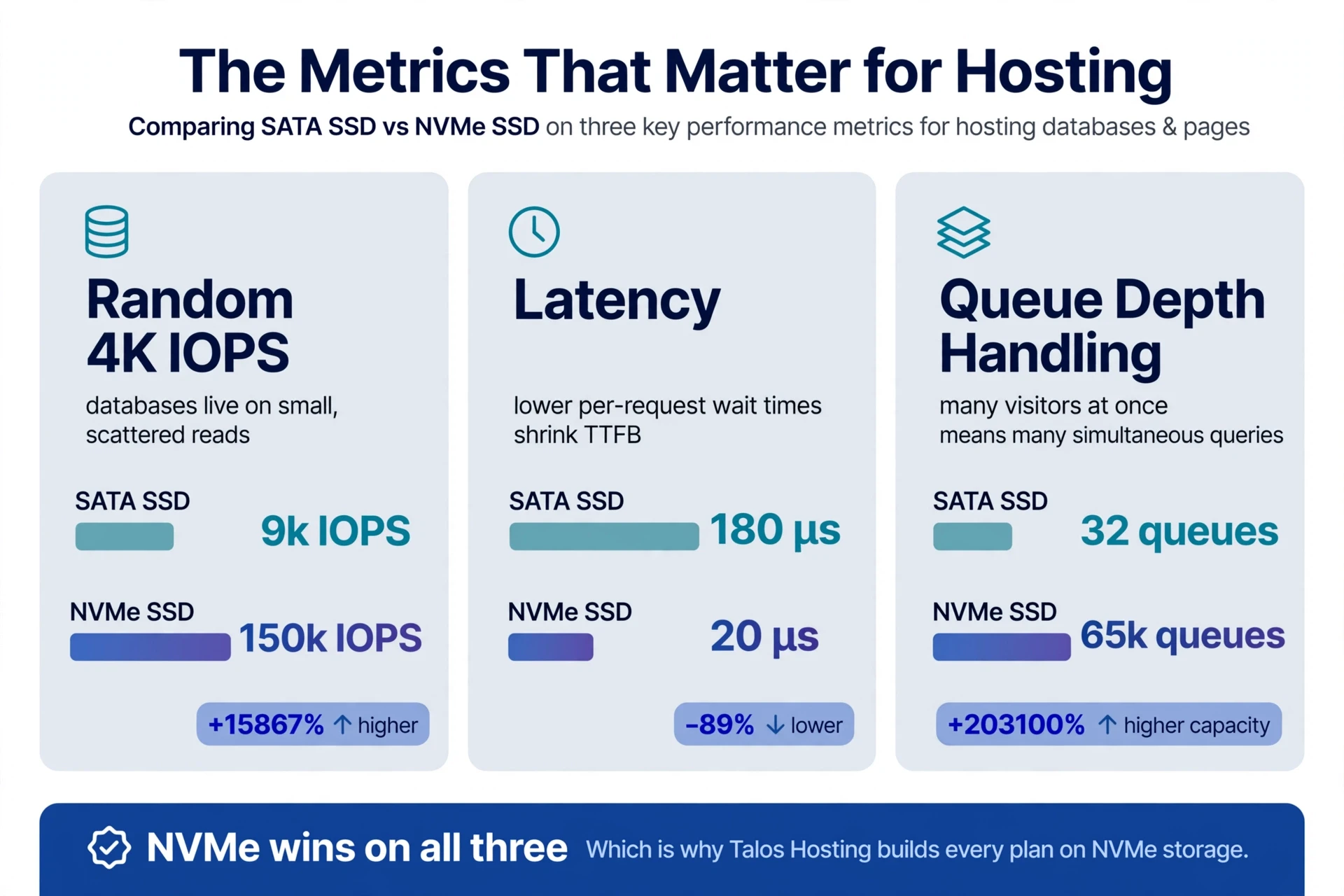
Ignore headline bandwidth. Three numbers decide how your database feels:
- Random 4K IOPS – databases live on small, scattered reads.
- Latency – lower per-request wait times shrink TTFB.
- Queue depth handling – many visitors at once means many simultaneous queries.
NVMe wins on all three, which is why Talos Hosting builds every plan on NVMe storage.
How NVMe Improves Database Speed and Page Responses
Databases hammer storage with thousands of tiny random reads. NVMe handles this far better than SATA because it talks directly to the CPU over PCIe and supports many parallel queues, not just one. Research on MySQL and Cassandra shows NVMe drives deliver up to 8x better performance than enterprise SATA SSDs for database workloads.
Why Database Queries Benefit Most
Queries live or die on latency. Every lookup, index scan, and write hits the disk in small random chunks. Under load, this shows up in worst-case times: one benchmark measured P99 MySQL query latency at 0.89ms on NVMe versus 12.4ms on SATA. That gap comes from NVMe’s parallel queues and a shorter data path to the CPU.
From Database Response to Faster Pages
Pages load faster because database time shrinks. WordPress and WooCommerce fire many queries per page view, so each query saved multiplies across a single request. Tests show database-backed pages dropping from over a second to well under half a second on NVMe. For shops, that means faster checkouts and fewer abandoned carts. Talos Hosting pairs NVMe with LiteSpeed caching to attack both sides at once.

Also Read: NVMe SSD Hosting: 8 Fast Plans for Speed-Heavy Sites
Who Should Choose NVMe Hosting?
NVMe hosting pays off most when your site hits the database hard. It’s often overkill for small, mostly static pages.
Workloads Likely to Notice the Difference
NVMe drives handle tens of thousands of parallel reads per second, which is why database-heavy sites feel the gap most. You’ll notice it if you run:
- Busy WordPress or WooCommerce stores with many simultaneous shoppers
- MySQL, MariaDB, or PostgreSQL servers under constant queries
- Membership sites, forums, or SaaS apps with logins and sessions
- Agencies or developers juggling staging and build workloads
When NVMe May Not Be the Main Fix
Static pages and low-traffic blogs barely touch the disk, so gains stay small. Web Host Pro notes that slow plugins, huge images, or missing caching often matter more than storage. Fix those first, then upgrade. Talos Hosting pairs NVMe with LiteSpeed caching, so both bases get covered.
Also Read: NVMe SSD Hosting vs SATA SSD Hosting: Real Differences
Is Talos Hosting Powered by NVMe SSD?
The Direct Answer
Yes. Talos Hosting runs on enterprise NVMe SSD storage, paired with LiteSpeed servers, out of US data centers. NVMe drives connect straight to the CPU over PCIe, so database queries wait far less than they would on SATA SSDs – benchmarks show NVMe with 10x lower tail latency under load.
Evaluate the Whole Hosting Stack
Storage alone does not make a fast site. Every plan needs the full picture:
- Web server: LiteSpeed handles more concurrent visitors than Apache.
- Data center location: US-only infrastructure keeps latency low for US visitors.
- Caching: Ask what server-side caching is included.
- Pricing: Talos uses lifetime plans with no renewal fees, unlike most monthly hosts.
Judge speed on the whole stack, not one spec.
Ready to cut your database and page load times? Explore Talos Hosting NVMe plans – lifetime pricing, no renewal fees, US-based performance built in.
Frequently Asked Questions
Q1: Is Talos Hosting powered by NVMe SSD?
Yes. Every Talos Hosting plan runs on high-performance NVMe SSD storage with LiteSpeed servers, all based in US data centers, so databases and pages load fast with no renewal fees.
Q2: Will NVMe hosting speed up my WordPress database?
Usually, yes. Queries that hit the disk finish much faster on NVMe, so busy sites with many plugins or large databases often see noticeably quicker page loads.
Q3: Do I need to change my code to use NVMe hosting?
No. NVMe works at the storage level, so your site, database, and applications run the same. You just migrate and enjoy faster response times.
Q4: Is NVMe worth it for a small blog?
If your blog gets steady traffic, yes. Faster disk reads cut load times, which helps SEO and keeps visitors from bouncing.
Conclusion
NVMe hosting speeds up databases and pages by removing the storage bottleneck: lower latency, higher IOPS, and faster queries under load. As Principled Technologies testing shows, NVMe SSDs processed 57% more database transactions than SATA. Talos Hosting pairs NVMe with LiteSpeed, so your pages and databases get that speed advantage by default.
NVMe SSD Hosting vs SATA SSD Hosting: Real Differences





No Comment! Be the first one.