
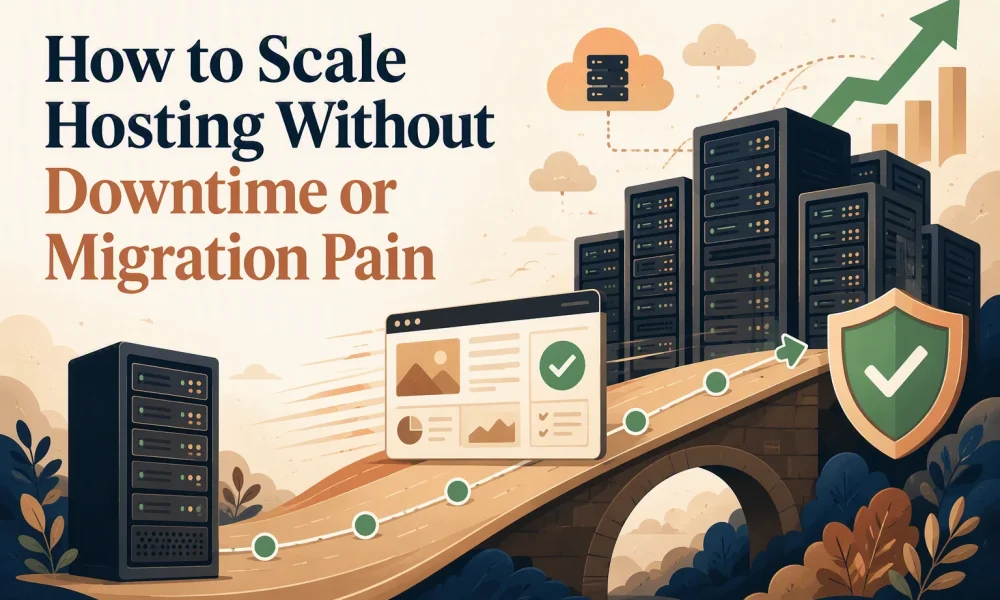

Quick Summary: Scale hosting by first measuring the real bottleneck, then choosing a hosting model that matches your traffic pattern. Before adding capacity, make your app portable and test a parallel environment to avoid migration pain. Automate scaling rules around sustained user harm, not brief spikes, and prove new capacity with load tests. Talos Hosting offers fast NVMe storage, LiteSpeed, US data centers, and lifetime hosting with no renewal fees.
At 9 a.m., an agency email lands. By 9:07, traffic triples and the site must either resize one server live or spread demand safely. That choice exposes the risk of rushed resource upgrades, failed moves, and lost sales. This guide shows how to plan resource upgrades, track limits, add resilient capacity, and migrate with no downtime. It draws on practical hosting patterns used for growing business sites.
Step 1: Find the Bottleneck Before Buying More Resources
Match the Fix to the Constraint
Measure first. More CPU or RAM will not fix a slow database query, large image files, or an uncached page. Google recommends finding the top bottleneck, fixing it, then monitoring for new issues. PageSpeed guidance lists app logic, database queries, CPU, and memory as common causes.

Check these signals during busy periods:
| Signal | Likely constraint | First fix |
|---|---|---|
| CPU stays high | Compute load | Review code, then add CPU |
| Memory fills | Too many active processes | Reduce plugins or add RAM |
| Slow queries | Database load | Index or cache frequent queries |
| High transfer time | Heavy assets | Compress images and cache files |
- Set a speed target.
- Test under real traffic.
- Apply resource upgrades only when data proves the need.
Tip: Cache static assets before expanding server size. It can reduce repeat load without a larger plan.
Also Read: Cloud Scaling vs Vertical Scaling for Web Hosting
Step 2: Choose the Hosting Model That Fits Your Traffic Pattern
Which Hosting Scales Best for Traffic Spikes?
Choose based on how traffic arrives, not just its monthly total. Cloud hosting fits sudden, short-lived spikes because resources can be provisioned quickly, a key cloud trait defined by NIST. Use a dedicated server when high traffic is steady and you need fixed, predictable capacity.
| Traffic pattern | Best-fit model | Why |
|---|---|---|
| Steady growth | VPS | Add resources with less disruption |
| Sale or viral spikes | Cloud hosting | Scale out during peak demand |
| Constant heavy use | Dedicated server | Keeps resources reserved |
| Many app instances | Load-balanced cloud | Spreads requests across servers |
Test the plan before a campaign. Ask how fast capacity grows and whether scaling needs a restart.
- Track peak CPU, memory, and database load.
- Keep headroom for launches and ads.
Also Read: Hosting Scalability: 8 Platforms Built for Fast Growth
Step 3: Remove Migration Pain Before Adding Capacity
Make the Application Portable
Move only after you can reproduce the site elsewhere. Keep files, settings, and database exports separate from the server. Record DNS, SSL, email, scheduled tasks, and third-party keys.
- Store backups off the live server.
- Set clear recovery time and data-loss limits.
- Write a rollback checklist.
NIST recommends tested recovery plans and realistic scenarios to limit service impact.

Tip: A portable app gives you choices. Capacity upgrades then become routine, not a risky rescue.
Build and Test the Parallel Environment
Create the new environment before switching traffic. Match versions, restore a recent database copy, and test key paths:
- Load pages and forms.
- Check checkout, logins, and email.
- Compare speed and error logs.
- Lower DNS TTL, then switch traffic during a quiet period.
Keep the old host live until checks pass. NIST also calls for recovery exercises and repeated testing.
Also Read: 7 Hosting Providers Built for Reliable Business Scalability
Step 4: Automate, Observe, and Prove the New Capacity
Scale on Demand Without Chasing Noise
Set scaling rules around real user harm, not brief traffic spikes. Watch response time, error rate, CPU, memory, and database waits. NIST research notes that auto-scaling can adapt as demand changes.
| Signal | Action |
|---|---|
| Sustained slow pages | Add capacity |
| Rising errors | Inspect the bottleneck |
| Short traffic burst | Wait before scaling |
- Set alerts with a delay window.
- Run a load test that mirrors peak traffic.
- Record baseline and post-scale results.
Tip: Prove capacity with repeatable tests, not a quiet dashboard. Keep rollback steps ready if latency or errors rise.
Scale with fewer surprises. Talos Hosting gives your site fast NVMe storage, LiteSpeed, US data centers, and lifetime hosting with no renewal fees.
Frequently Asked Questions
Q1: Which hosting scales best for traffic spikes?
Cloud or managed hosting with load balancing scales best. Add capacity before campaigns, monitor CPU and memory, and test peak traffic.
Q2: Can I scale hosting without moving my website?
Yes. Upgrade server resources first. If limits persist, use load balancing and separate databases.
Q3: How do I prevent downtime during migration?
Copy files, sync databases, test the new site, then switch DNS during low traffic.
Conclusion
Scale hosting through measurement, staged upgrades, redundancy, and tested cutovers. A documented recovery plan supports fast restoration and business continuity, as NIST guidance explains.

Lifetime Hosting: 7 Providers With No Renewal Fees
Cloud Scaling vs Vertical Scaling for Web Hosting




No Comment! Be the first one.